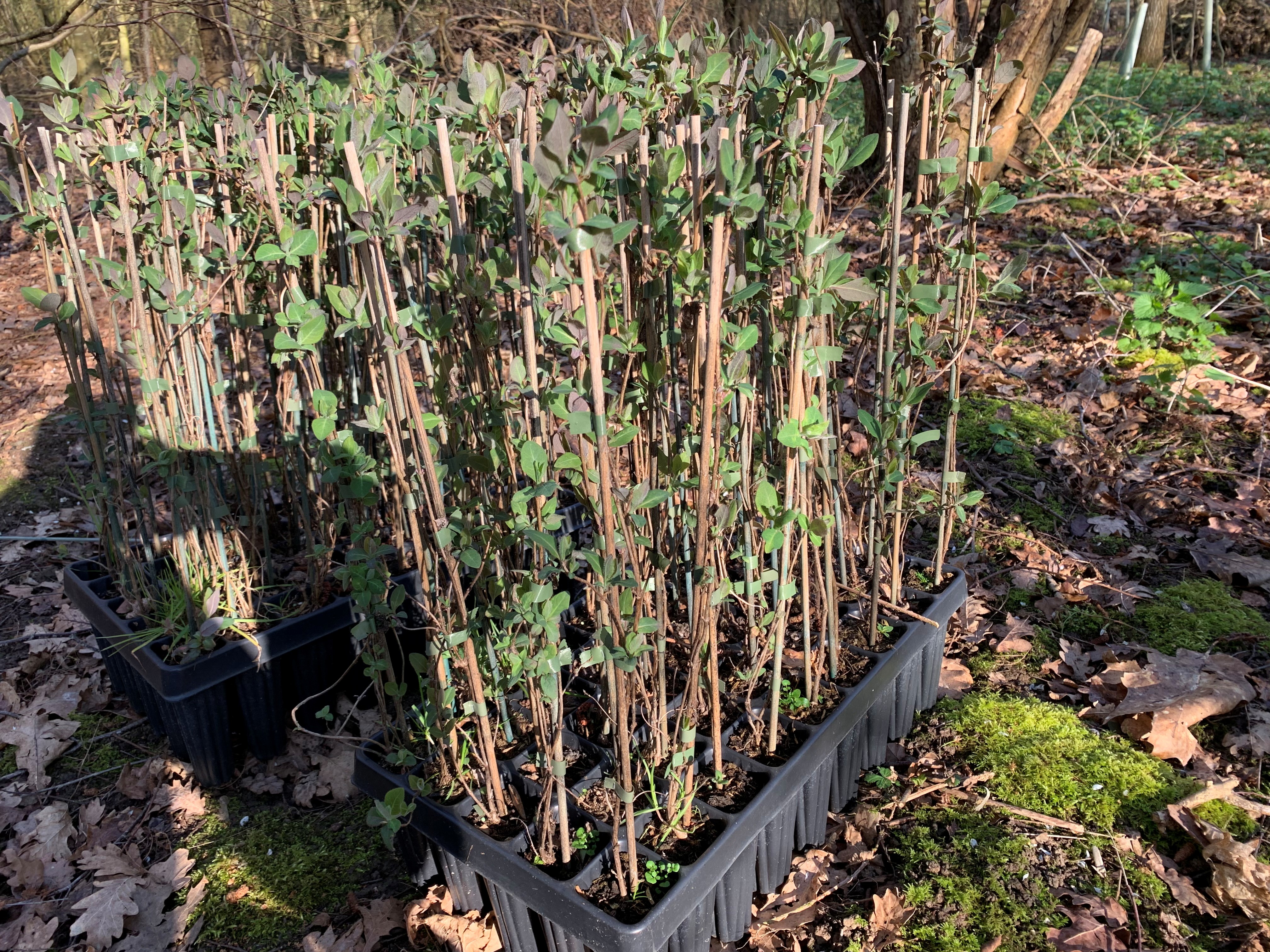
Planting Honeysuckle in New Woodlands and Hedgerows

Honeysuckle, Lonicera periclymenum, is an important plant in natural lowland habitats. It is the only food plant of the white admiral caterpillar; dormice use strips of its bark to make their nests. Its scented flowers attract pollinating insects and moths. But, because it is a climber, not a tree or shrub, it rarely appears on the planting list when a new woodland or native hedge is being planned.
So, when and how should honeysuckle be planted? For a native hedgerow, wait 2 or 3 years after planting, then plant at intervals along the hedge line. No need to find a gap, the honeysuckle will soon make its way out the top of the hedge. Planting in a new woodland requires more careful timing.
When a woodland reaches canopy closure and the ground becomes bare of plants, it is time to start managing the woodland by thinning the trees and coppicing. The woodland manager should take advantage of the extra light reaching the woodland floor to establish the honeysuckle. Honeysuckle is a shade bearing plant that comes into leaf early to take advantage of any Spring sunshine, but it needs to reach the full sunlight before it will flower and produce berries.
There are at least 3 ways that honeysuckle could be planted in a woodland.
Firstly, plant beside any coppiced hazel stools. A 60cm tree guard will protect from rabbits and point the honeysuckle into the centre of the stool where fast growing hazel shoots will provide support for the young plants. If you choose a hazel stool on the woodland edge, within a few years the honeysuckle will burst out of the hazel canopy as a patch of exotic-looking pink flowers and, later, red berries. Examine the hazel shoots to see if there are any potential corkscrew walking sticks.

Any thinning and brashing work will produce large quantities of branch wood which could be made into heaps. Plant honeysuckle on the edge of these heaps. The sticks will protect the plants from browsing herbivores and provide support for climbing plants. Tree guards may not be necessary.
Finally, a stand-alone oak tree could provide the necessary support. Plant 2 or 3 honeysuckle around the base of the tree and push branchwood into the ground around the tree. Sisal string can hold the branches tight against the tree until the honeysuckle has grown up to the lower branches of the oak tree.
Plant into wet ground in winter to allow the roots to settle before the shoots start growing in February.